
Misplaced Mindset - the root of all organization dysfunction
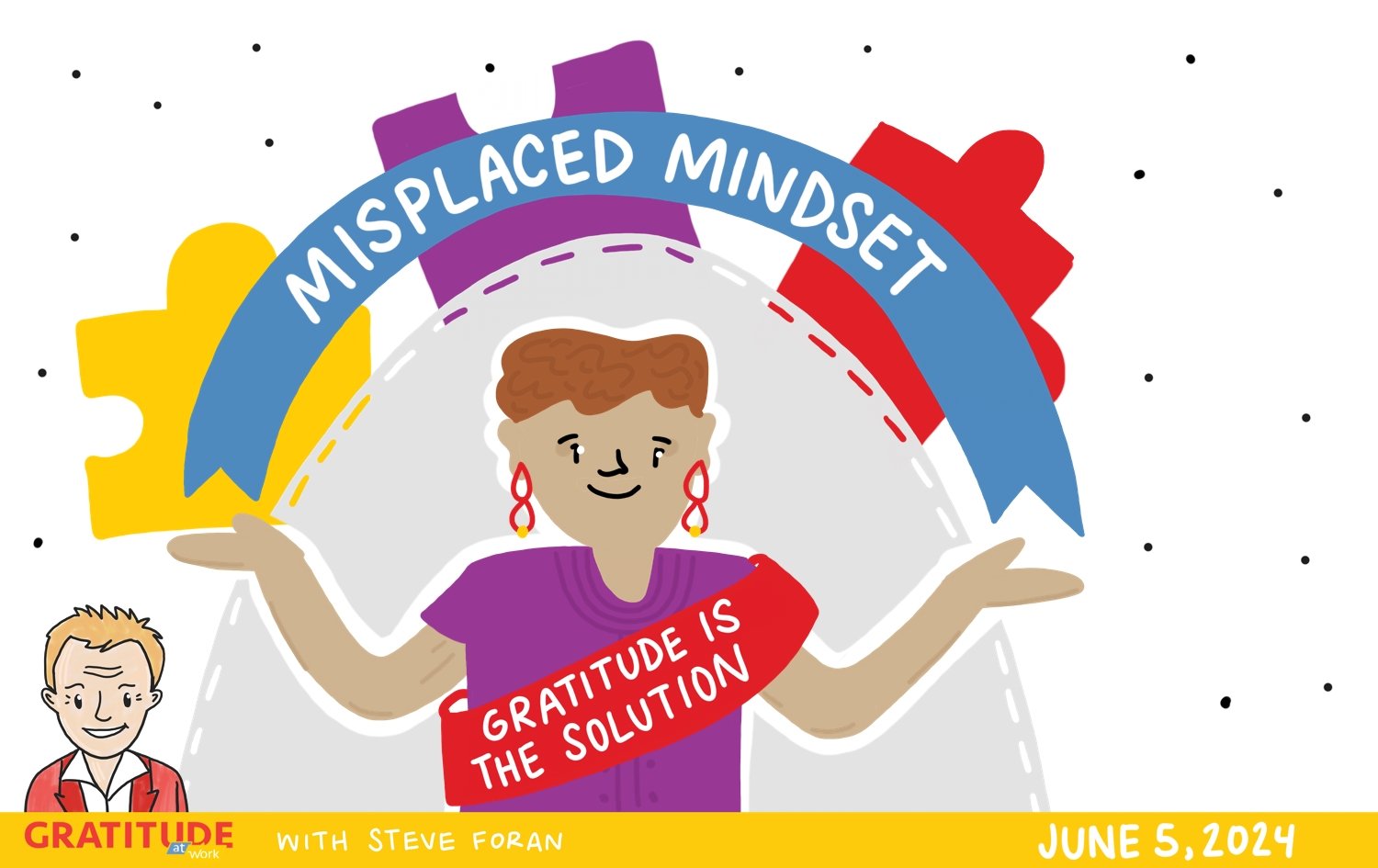
Have you ever witnessed someone go from fully engaged at work to within a few months, all out rebellion ? This happens because of what I call, Misplaced Mindset - and unfortunately it’s completely natural.
Over time people misplace their mindsets. What was once dearly valued (benefits, flexible hours, compensation, scope of responsibility, remote work - the list is endless) is now taken for granted. It’s not deliberate and no one is trying to do anything devious, Misplaced Mindset happens because of adaptation, which is the human tendency to assign less value to the familiar. Left unchecked, Misplaced Mindset can turn into full blown resentment. It can happen in all aspects of our lives - personal and work.
Misplaced Mindset happens to individual contributors, to managers, to executives and to business owners - yes, even the top dog. No one is immune to it.
Have you ever personally participated in or witnessed any of these toxic behaviours ?
talking about people behind their back
taking advantage of sick time or working conditions
complaining
poor customer service
failing to follow basic process that is known and understood
blaming
ignoring values to achieve results
underperforming
exploiting staff
On the surface, it may appear the reason for the behaviour is lack of training or stress or being under-resourced or whatever, but if you dig deeper and keep asking why, you’ll discover the root cause. As you peel back the onion as to why any of these behaviours occur, it will always come back to a mindset that fails to recognize the good fortune and opportunity one possesses. Bottom line, I believe Misplaced Mindset is at the core of all organizational dysfunction.
The solution
To prevent Misplaced Mindset and the subsequent organizational dysfunction, you must equip each person in your organization with tools to build and maintain a world-class mindset of excellence. There are a number of ways to achieve this, but my recommended tool is gratitude. Gratitude is simple, effective and practical.
Gratitude is a harbinger that continually reminds us there is good and nudges the mindset to refocus our perspective towards being solution driven. Gratitude helps us notice when we Misplace our Mindset and then motivates us to do something about it. Over time, gratitude helps prevent the Misplaced Mindset - in fact, it helps the mindset default to a positive, goal-oriented perspective striving for excellence. Recent research suggests that gratitude enhances the cardiovascular response in acutely stressful situations and subsequently drives collaboration and improves individual performance. Researchers found that being grateful reduced the sense of threat in high-stress situations and stimulated what you would describe as generative problem solving.
Successfully engraining gratitude into the collective mindset of your organization relies in having a long term orientation towards continuous improvement. Avoid the temptation to seek immediate gratification. This is a journey of mastery.
To get started on Misplaced Mindset, give us a call or please make use of our do-it-yourself Playbook for More Gratitude at Work available for free here.
Get our Keeping Level blog delivered to your inbox as soon as it’s released every second Wednesday.
This story from a golf course highlights a common leadership blind spot: we expect others to step forward without considering whether we’ve created the conditions that make it possible.
👉 Watch the full story to discover how great leaders create true belonging 🎥

Leadership is often associated with having the right answers. But in today’s complex world, the real advantage lies in asking better questions and creating space for reflection.
Through years of facilitating executive groups, I’ve seen how removing the pressure to “fix” leads to deeper, more honest, and more impactful insights.
This video explores a simple yet powerful practice you can use immediately with your leadership team.

Most leaders underestimate the impact of what they “go on about.”
During a CEO peer group retreat at North America’s first single malt whiskey distillery, an unexpected voice cut through collective silence. This story explores leadership, group dynamics, and why outsider perspective can be the most powerful force in a room.

Most leaders underestimate the impact of what they “go on about.”
This story-driven video reveals how casual negativity can become a leadership reputation—and shape what your team feels safe to suggest or try.
A simple reminder with big implications for culture and communication.
👉 Watch now ▶️
Leadership often lives in the space between words—and that’s where things quietly fall apart.
This brief, personal story illustrates why clarity is one of the most underestimated leadership skills.
👉 Watch the video 🎥 and explore how to close the gap before gravity does.

Great leadership isn’t always loud or exciting. Often, it’s the quiet consistency that makes people feel safe. In this post, I share a simple family story that reveals why stability is one of the most underestimated leadership qualities—and why protecting it matters more than ever.
▶️🦖 Watch the video

Standing on sacred ground at Vimy Ridge, I realized something essential about leadership: people don’t follow numbers—they follow meaning. This reflection bridges history and modern leadership in a powerful way. 🎥👇
👉 Watch the video and consider the story you’re telling your team.
Organizations rarely “choose” dysfunction. More often, they drift—one copied workaround at a time—until inefficiency becomes the standard operating system. Whether it’s outdated norms, clunky tools, or unnecessary steps, the pattern is the same: when no one questions the default, the default wins.
This video gives you a simple, practical prompt to reset your team: audit one habit they copy from you.
▶️ Watch the video ✅🎬
In 1987, at my first job as an engineer, my boss’s boss—Fraser Blair—felt larger than life. He had a booming voice, a big presence, and a senior title that honestly intimidated me. One day I asked him a simple question about the origin of “Mahone Bay.” That night, at 10pm, he called me at home with the answer. That quiet act of follow-through completely disarmed my fear and built a bridge of trust and camaraderie that changed how I worked.
This experience taught me a lesson I’ve never forgotten: follow-through builds trust faster than authority. In this short video, I share the story and invite you to consider one outstanding commitment you could close today—an email, an introduction, a decision, a promise.
👉 Watch the video below and reflect on how your own follow-through shapes trust at work. 🎥

“Steve, I’ve tried the gratitude list thing… it just doesn’t work for me.”
That’s what a participant told me at a recent gratitude retreat. Her experience is more common than you might think. A lot of people—and a lot of leaders—are faithfully writing gratitude lists that never really touch the heart. The problem isn’t gratitude itself; it’s that we’re only practicing one-third of it.
In this video, I walk through three components of meaningful gratitude:
In the video below, I share how I shifted from vague expectations to a clear, five‑minute integrity talk that spelled out what cheating looked like, what the consequences were, and why it mattered. More importantly, I share the leadership question that changed everything: “What did I not say, clarify, model, or reinforce that might have made this outcome more likely?”
In 1997, I bought a Mother’s Day gift that backfired – and it changed how I lead. I realized that good intentions don’t automatically translate into positive impact. This principle applies to teams, decisions, and relationships. In this post, I share the story and the question every leader should ask before acting.
Leadership isn’t about avoiding challenges—it’s about how you respond when they hit close to home. I learned this after catching a student cheating in an ethics exam. My instinct was personal, but the right response was principle-based. Here’s the full story and the lesson every leader needs.
After more than a decade of running the same trail, I thought I knew every regular. Then, one day, I met someone I already knew—and had never seen before.
That moment reminded me of a truth every leader needs to hear: the more experience you have, the more likely you are to miss something important.
Blindspots aren’t harmless—they’re costly. In this post, I’ll share why staying curious and humble is critical for leadership success.
👉 Watch the video and start uncovering what you’re missing! 🎥
Ever notice how kids never stop asking “Why”? Last week, my 3-year-old grandson reminded me of something powerful: as adults—and especially as leaders—we often stop asking, and even worse, we stop answering.
When you make changes in your organization, your team is just as curious as a child… but they’ll only ask once. If your answer doesn’t make sense, trust erodes. In this video, I share a simple truth about why explaining your “why” matters more than you think.
👉 Watch now and discover how to build trust by embracing curiosity.
<more>

Sometimes the biggest relief comes from finally doing the thing you’ve been putting off.
In this short story, I share a personal experience that reminded me how often leaders delay decisions—even when the tools and resources are right in front of us.
If you're a CEO or business leader, this one's for you.
👉 What decision are you sitting on that could unlock clarity, growth, or momentum? <more>

Ever heard of pronoia?
It’s the opposite of paranoia—the belief that the universe is conspiring in your favour.
Last weekend, two friends sent me an article on gratitude from the NY Times. I hadn’t seen it yet, but they had me covered.
Fifteen years ago, my reaction would’ve been very different. <more>

One of my weekly check-ins with my boss 30 years ago is embossed in my mind. Watch the video to find out why ! <more>
The nurse asked me a routine medical question that made me freeze:
"Do you do any recreational drugs—like <more>
Last week our daughter Stef drops off 2 year old Mae at daycare. Accompanying her is our 10 year old grandson Max.
What happens next is amazing <more>

It’s July 31. We finish dinner and I say,
“Max, let’s get your sister in the stroller and go for a walk around the neighbour.”
“Sure thing Bump."
As we’re passing the school where Max will be going into grade 5, <more>
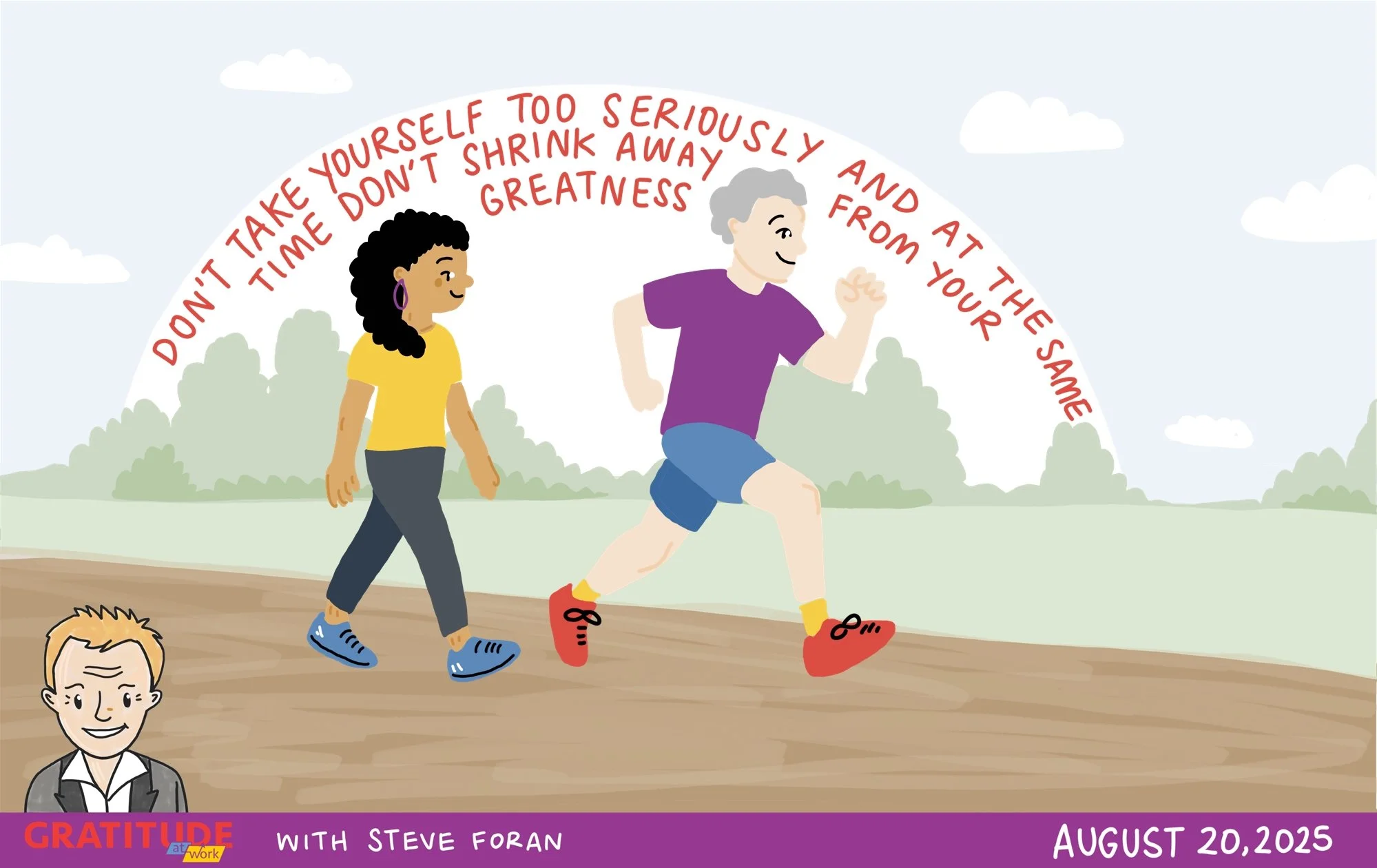
I have a few standard lines when I pass people from behind while running on our local trail.
As I’m coming up to pass, you’ll hear me, <more>

Imagine you’re heading out on summer vacation. Your 4 year old and 7 year old are all excited and jabbering away in the back seat. You double check the trailer hitch to make sure the camper is securely attached and pull out of the driveway at 9:30am. You figure you’ll be at today's destination by 3pm and you think back to when you were one of the kids in the back seat. You glance at your partner, “It’s beautiful out, I’m really looking forward to the drive.".
You’re not one kilometre from home and you hear a loud noise and then see <more>

Tomorrow we head out for our annual family vacation— kids, spouses and grandkids. It’s something we all look forward to each year. Unfortunately, we’re down one person this year as our son-in-law is on an extended voyage at sea for his work with the Navy.
As the grandkids have gotten older, we’ve <more>

After 4 years in our new house I decided to put a few finishing touches on the garage. Specifically, paint the floor and take the rough "construction look" out of a small set of steps.
I move stuff from one side of the garage to the other, paint and then reverse the process for the other side. I think I handled everything in the garage <more>

I’ve been thinking about retreats a lot lately. Probably because I just finished two this month, finalizing one in July and a few on the docket in the fall.
This "retreat thinking" caused me to recall <more>

This past weekend we were looking after our 2-year old granddaughter, Maesey, for an hour or so to cover for our daughter who wanted to get out for a long run.
We did the usual kid activities—some food, some colouring, some hide-the-duckies, some toys and some reading.
What strikes me is her <more>

A few weeks back I was speaking with the senior leadership team of a large national police force. During one of the exercises someone asks, "In our work, we are constantly barraged with negative situations. What advice do you have so that we can be grateful ?" He goes on, "Our work is <more>
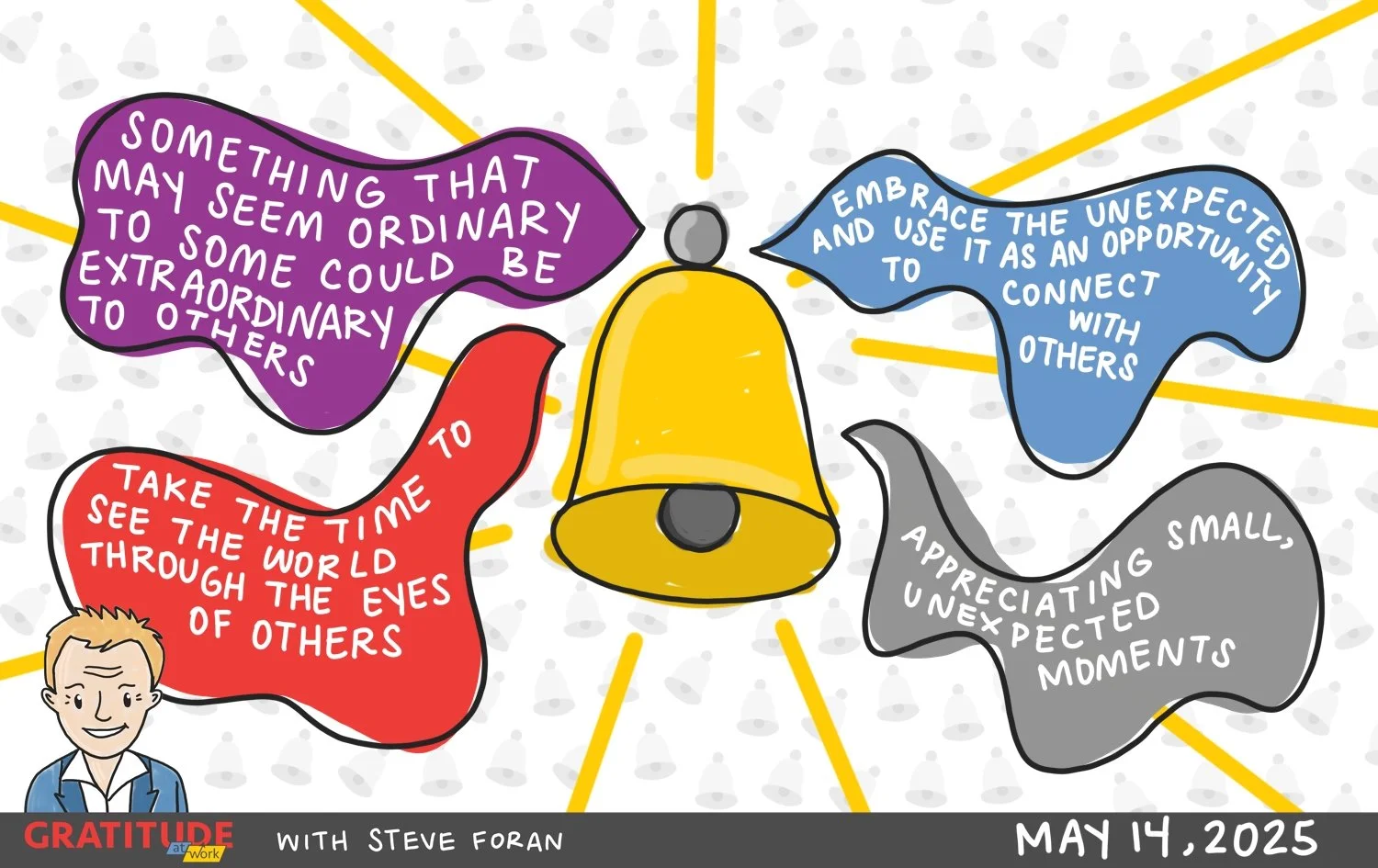
Last week I’m checking out of my hotel. It’s early in the morning. I approach the reception desk and notice a brightly coloured service bell 🛎️ on the counter.
I look at the Front Desk Associate and say, "Nice bell." Then I slowly reach into my briefcase and presto—I pull out <more>

Why does knowing a process is risky so rarely lead to fixing it? That question sits at the center of this short video from Steve Foran, a professional speaker with a background in safety who spent years removing avocado pits the unsafe way — hand in the line of fire — despite knowing exactly what he was risking.
Emergency rooms have a name for the resulting injury: avocado hand. Steve's shift came not from new information, but from watching a five-second, zero-risk method someone else had been using all along.
The lesson for leaders: awareness of a risk and action on a risk run on separate tracks, and teams tolerate known-flawed processes until they fail. A leader's job is to build the pause between the two.
🎬 Watch now, then take 15 minutes this week to ask your team what risk they've been quietly tolerating.
👉 Watch the full story to discover how great leaders create true belonging 🎥